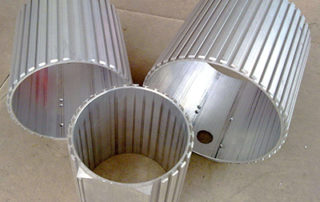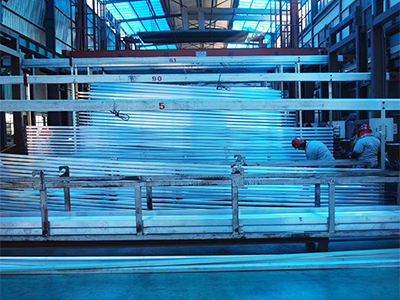
In today’s high‑power electronics, automotive thermal management, and precision instrumentation, heat dissipation is no longer a secondary concern—it is a critical performance bottleneck. Among the many solutions available, aluminum extruded heat sinks with high‑density fins stand out for their exceptional balance of thermal conductivity, lightweight construction, and design flexibility. As power densities continue to rise, the demand for ever more intricate and efficient heat sink profiles has grown exponentially.
Yet, producing these complex shapes is far from straightforward. The true enabler—and often the limiting factor—is the extrusion die. A well‑designed die transforms a billet of soft aluminum into a precision‑engineered heat sink with dozens of slender, closely spaced fins. A poorly designed one leads to non‑uniform flow, premature tool failure, or unacceptable dimensional tolerances.
This blog post delves into the art and science of die design for aluminum heat sink extrusions. Drawing on practical industrial examples, we will explore the core philosophy behind successful designs—balancing metal flow, minimising impact on cantilevered fins, and enhancing die strength and rigidity. We will then walk through several design approaches for different classes of heat sink profiles, from large industrial radiators to miniature high‑precision fin arrays. Finally, we share real‑world case studies and discuss the broader factors that influence extrusion success. Whether you are a process engineer, a tool designer, or a procurement specialist, we hope this discussion offers valuable insights for your next project.
1. Understanding Aluminum Heat Sink Profiles – Characteristics & Classification
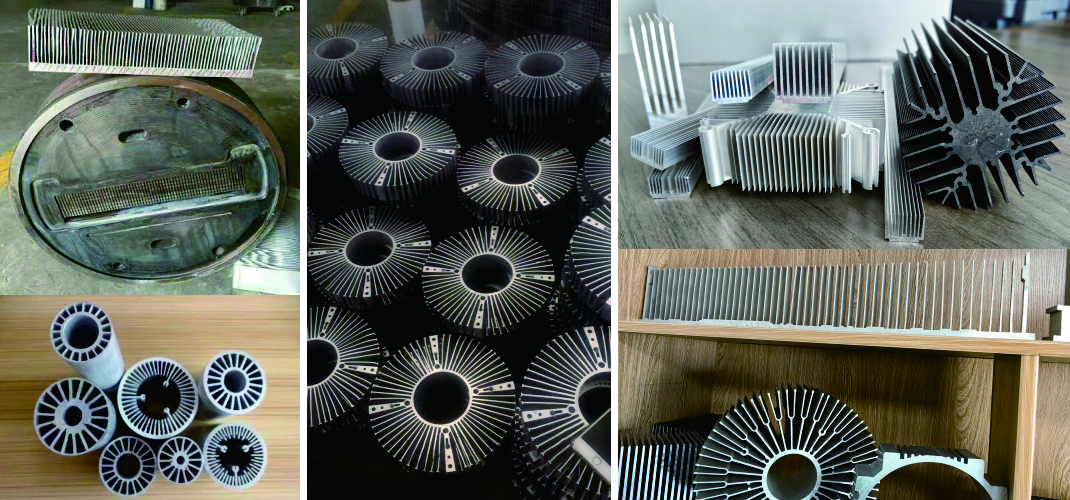
Aluminum itself is an excellent thermal conductor, but its real advantage emerges when we maximise the surface area exposed to the cooling medium. By extruding tall, thin fins with narrow gaps, we multiply the effective heat‑transfer surface without increasing the footprint. This principle underpins the widespread adoption of aluminum heat sink extrusions in air‑conditioning systems, electric vehicles, server farms, and laser diodes.
In practice, these profiles fall into two broad categories:
Because most heat sink alloys are based on pure aluminum or soft 6xxx‑series grades, they permit the use of spreading‑and‑diverting die configurations that widen the material stream before it reaches the bearing. This flexibility, however, does not simplify the design—it merely opens the door to creative solutions.
2. Die Design for Large Heat Sink Profiles – Structural Principles and Methods
Large heat sink extrusions are predominantly solid profiles. Their defining challenges include a large circumscribed circle diameter, highly complex cross‑sectional geometry, wide variations in wall thickness (from thick base to razor‑thin fins), and closely spaced fins that create long, unsupported cantilevers. When the section ratio (base‑to‑fin thickness) and tongue ratio exceed certain thresholds, a conventional flat‑die (without flow‑control features) invariably fails—either by producing intolerable twist and bow, or by fracturing the bridge under the high extrusion pressure.
To overcome these obstacles, the industry has developed several proven die architectures.
a. The Wide‑Spreading Diverting Die
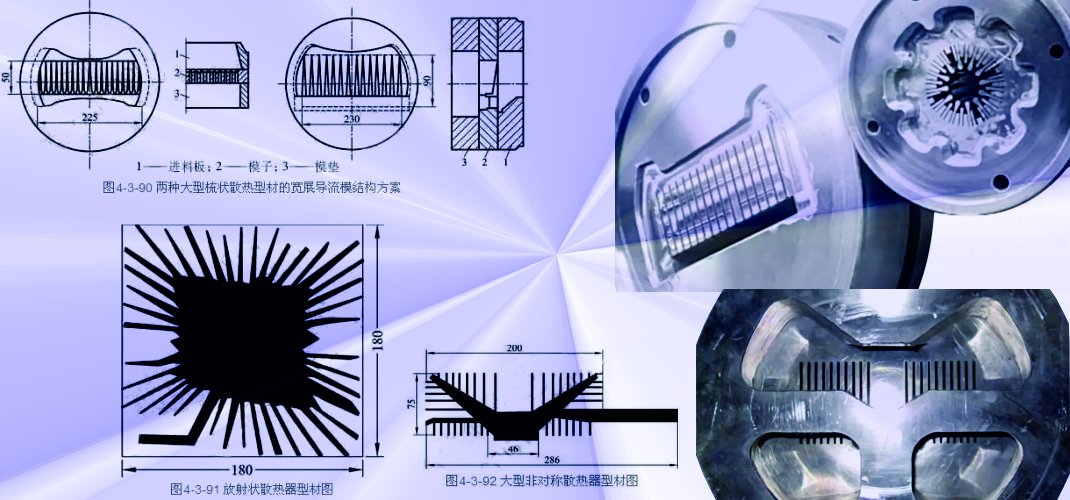
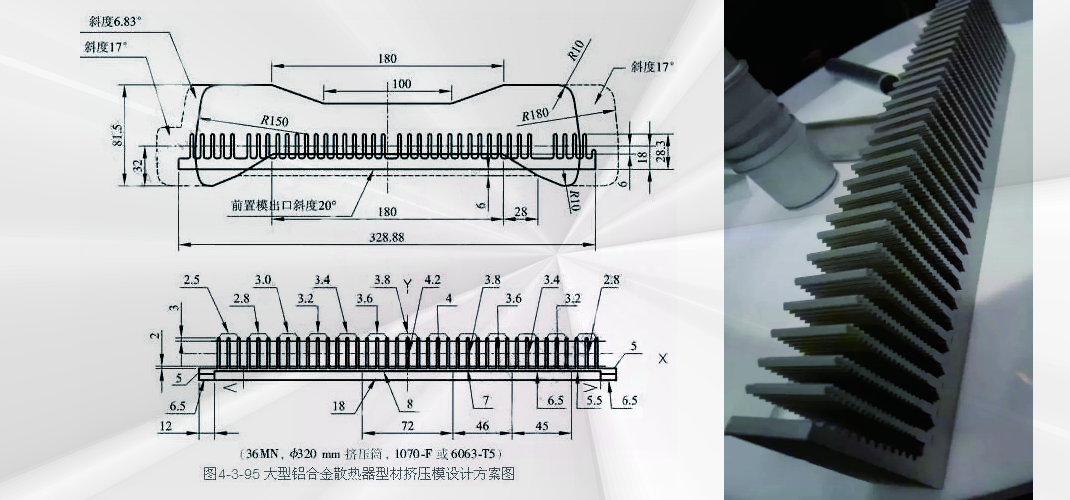
This design (illustrated conceptually in typical tooling manuals) is used on a 25 MN press with a φ260 mm billet to produce large comb‑shaped heat sinks with circumscribed circles from 200 mm to 340 mm. These profiles demand strict flatness and parallelism, have high tongue ratios, and exhibit a drastic thickness difference between the solid backplate and the fins.
The die incorporates a spreading zone and a flow‑diverting pre‑chamber. At the centre, the pre‑chamber closely matches the final fin pattern, but towards the edges it expands in a fan‑shaped manner. This geometry accelerates the metal flow at the periphery, compensating for the natural tendency of the billet centre to flow faster. By carefully tuning the expansion angle and depth, the designer achieves a nearly uniform velocity profile at the bearing entrance, thereby reducing bending moments on the slender fins.
b. The Split‑Die (Bridge) Combination
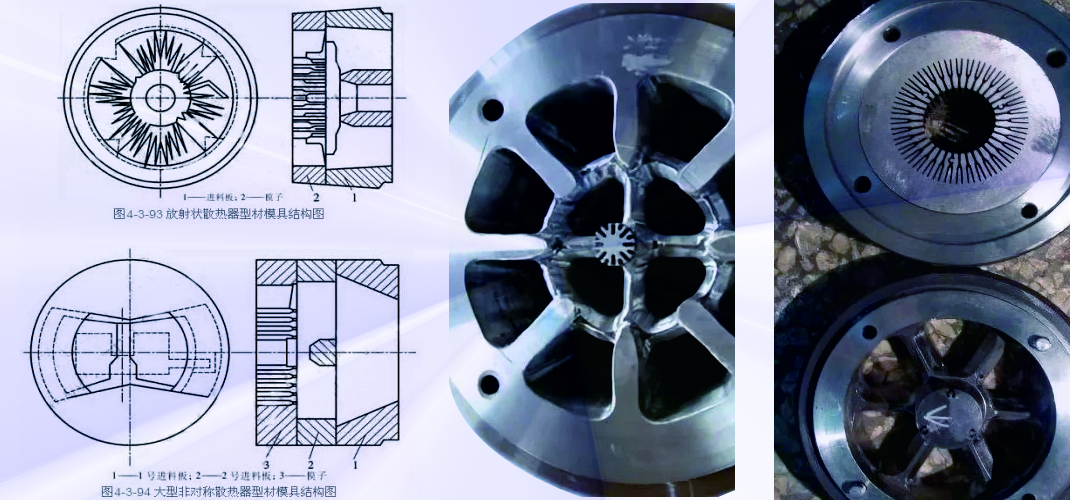
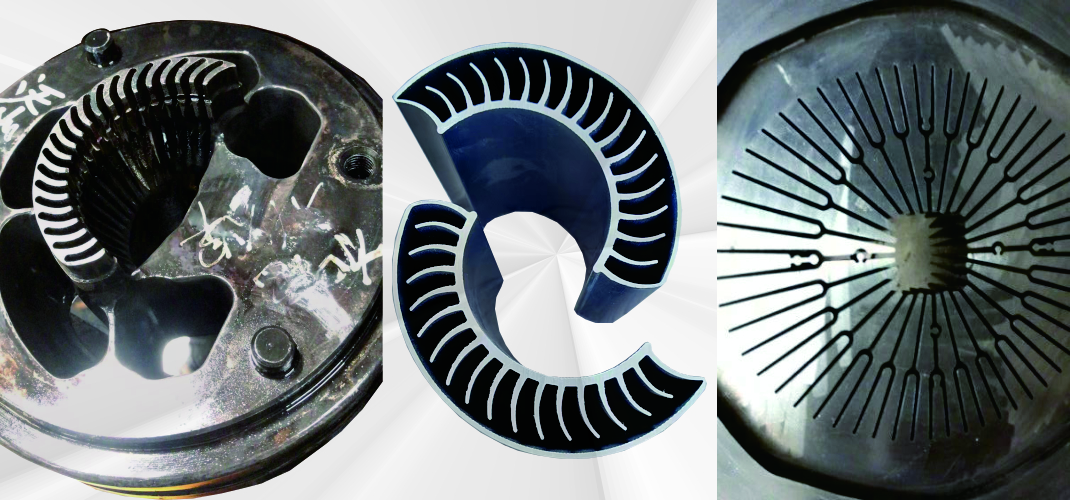
Some heat sink profiles present even more formidable challenges: the section ratio may exceed 100, the fins radiate outward like a starburst, and their tips lie near the edge of the extrusion container—where the metal velocity is inherently low, while the centre runs fast. Moreover, wavy or corrugated fin shapes increase surface area but introduce severe flow instabilities. The long overhangs make it almost impossible to guarantee sufficient rigidity of the cantilever during pressing.
Conventional single‑piece dies simply cannot cope. After extensive study of metal flow mechanics, the interaction of die elements, and the effect of each structural parameter on exit velocity, engineers developed two specialised split‑die configurations:
c. Design Specifics for High‑Precision Electronic Heat Sinks
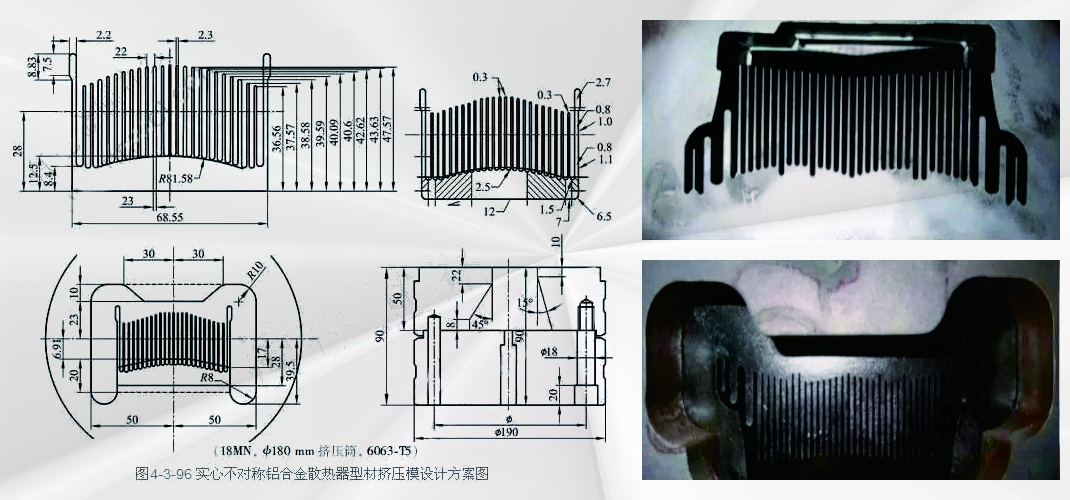
For the small, high‑fin‑density profiles used in electronics, the stakes are even higher. Tolerances are often measured in hundredths of a millimetre, and the tongue ratio can be extreme. Such profiles demand specialty dies manufactured from premium wrought and pre‑treated hot‑work tool steel (e.g., H13 with enhanced toughness). The die hardness should be carefully controlled—excessive hardness or nitriding can promote cracking under cyclic loading, so a slightly lower hardness with higher fracture toughness is preferred.
The design philosophy centres on precision flow allocation. Every geometric parameter is meticulously calculated: the bearing lengths at each fin and at the base, the exit relief angles, the width and depth of the spreading chamber, and the taper of the diverting passages. Even the slightest imbalance in bearing length will cause fin tilting or thickness variations. Furthermore, the manufacturing process must adhere strictly to the drawing tolerances; any deviation—even a few micrometres—can ruin the delicate flow balance.
It is also worth emphasising that for these high‑difficulty profiles, die correction (trimming) and extrusion parameters (billet temperature, ram speed, and cooling rate) are equally critical. A perfectly designed die can still produce scrap if the press operator does not maintain strict process control.
3. Practical Case Studies – Proven Die Designs in Production
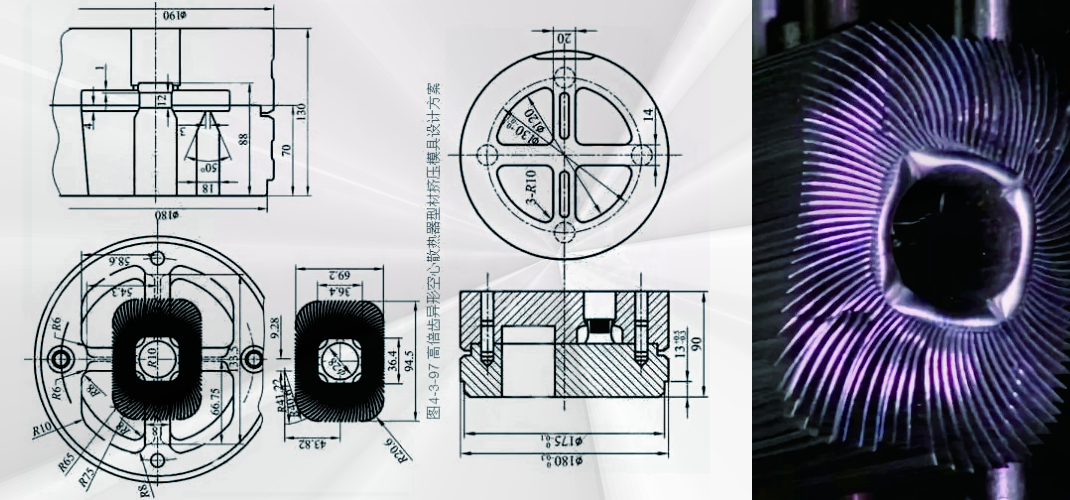
The theoretical principles discussed above are not academic—they have been validated through countless production cycles. Figures 4‑3‑95 through 4‑3‑98 (in the original reference) show several representative die designs for various classes of aluminum heat sink profiles. These blueprints have withstood the test of mass production, delivering consistent quality and acceptable tool life under normal industrial conditions.
However, we must caution that no two extrusion plants are identical. Press capacity, billet quality, lubrication practices, and even the ambient workshop temperature can influence performance. Therefore, while these designs serve as excellent starting points, they should be adapted to the specific constraints of each facility—such as press tonnage, container diameter, and available cooling systems.
4. Beyond the Die – A Holistic View of Heat Sink Extrusion
It would be a mistake to attribute all extrusion challenges solely to die design. In practice, the success of producing high‑quality heat sink profiles depends on a constellation of factors:
Each heat sink section is unique; its geometry dictates the optimal combination of die type, press settings, and auxiliary measures. There is no one‑size‑fits‑all solution. The designer must weigh the tongue ratio, the section modulus, the symmetry of the profile, and the production volume to choose the most robust strategy.
5. Final Thoughts – Pushing the Boundaries of Extrusion Die Engineering
The evolution of heat sink die design is a testament to the ingenuity of extrusion engineers. By transforming a simple cylindrical billet into a delicate, high‑surface‑area profile, they overcome formidable mechanical and thermal hurdles. The key takeaways from our discussion are:
We hope this exploration provides a useful reference for those involved in the design, manufacture, or procurement of heat sink extrusions. As thermal management demands continue to escalate, we can expect even more innovative die concepts—perhaps incorporating additive manufacturing or smart sensors—to emerge. Until then, the time‑honoured principles of metal flow control and structural integrity remain our guiding stars.
What Does Hoonly Do?
In the fast-evolving aluminium extrusion industry, businesses across automation, manufacturing, construction, [...]
4 Advantages of T‑Slot Aluminium Framework
When you walk onto a modern factory floor, you will likely [...]

Aluminium China 2026: 5 Signals That the Industry Is Breaking Cycles and Forging Ahead
This July 8–10, the Shanghai New International Expo Centre buzzed with [...]
Exploring Die Design for Aluminum Extruded Heat Sink Profiles
In today’s high‑power electronics, automotive thermal management, and precision instrumentation, heat [...]